DOCUMENT
Preserve original photos, video, date, location, conditions, and witness notes.
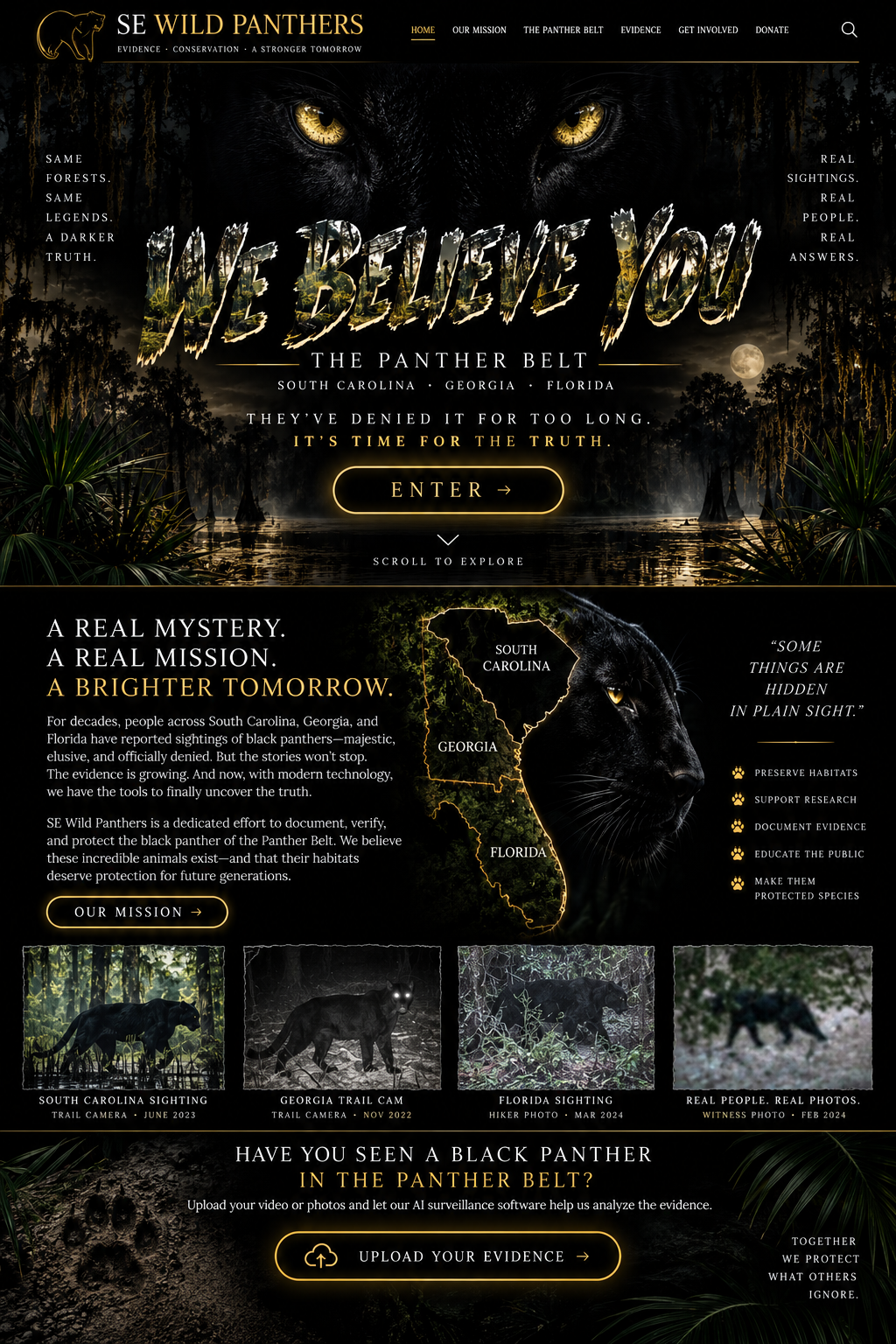
For generations, people across the Southeast have described encounters with unusually dark, large cats. Our purpose is not to declare every report true. It is to give serious witnesses a serious place to document what they saw, preserve original media, compare details, and build an evidence trail that can be examined rather than dismissed.
Preserve original photos, video, date, location, conditions, and witness notes.
Separate compelling evidence from misidentifications, edits, compression artifacts, and folklore.
Use verified wildlife evidence to strengthen public support for habitat connectivity and responsible conservation.
We use “The Panther Belt” as our project name for the southeastern corridor where reports, historic range, suitable habitat, and modern wildlife movement intersect. Florida panthers are real and federally endangered; wildlife agencies also note that Florida panthers/pumas are normally tawny rather than black. That scientific tension is exactly why extraordinary reports need extraordinary documentation.
Coastal plain, river swamps, pine forest and long-running eyewitness lore.
A geographic bridge between Florida habitat and the wider Southeast; agencies receive large-cat reports but do not recognize a resident mountain-lion population.
Home to the surviving breeding population of endangered Florida panthers, primarily in the southern peninsula.
The strongest submissions keep the original file and include enough context to test scale, distance, location and timing. We encourage witnesses to submit even when they are uncertain.
Upload the unedited file when possible. Screenshots and reposts lose useful metadata and detail.
County and nearest town are useful. Exact coordinates are optional and can be treated as sensitive habitat information.
Fence posts, road width, tree trunks and repeat photos from the same viewpoint can help estimate size.
Describe gait, tail length, speed, sounds, direction of travel and how long the sighting lasted.
Submitted photos and videos may be evaluated using AI-assisted image-analysis tools as part of the evidence-review process. Automated review is intended to help identify features worth closer examination and to support subsequent human review—not to replace scientific verification.
Media submitted to SE Wild Panthers may be examined using automated image-analysis tools and subsequent human review. Automated screening may evaluate visible animal characteristics, body proportions, apparent coloration, environmental context, image quality, metadata when available, and possible signs of manipulation or misidentification.
AI-generated assessments are investigative aids only. They do not constitute scientific confirmation of species, melanism, authenticity, geographic origin, or the existence of a resident or breeding population. Significant findings should be independently reviewed and corroborated by qualified wildlife experts before being described as verified.
Submit the original media and write down details while the memory is fresh.
Preserve trail-camera originals, note camera height and direction, and avoid baiting protected wildlife.
See evidence tips →Help us build standards for image review, field verification, species identification, and chain of custody.
Partner with the project →This project is being built as an evidence-and-conservation initiative. We will not collect donations through this page until a legitimate receiving organization or payment account is connected. In the meantime, you can support existing panther conservation through official wildlife programs and help by documenting habitat responsibly.